


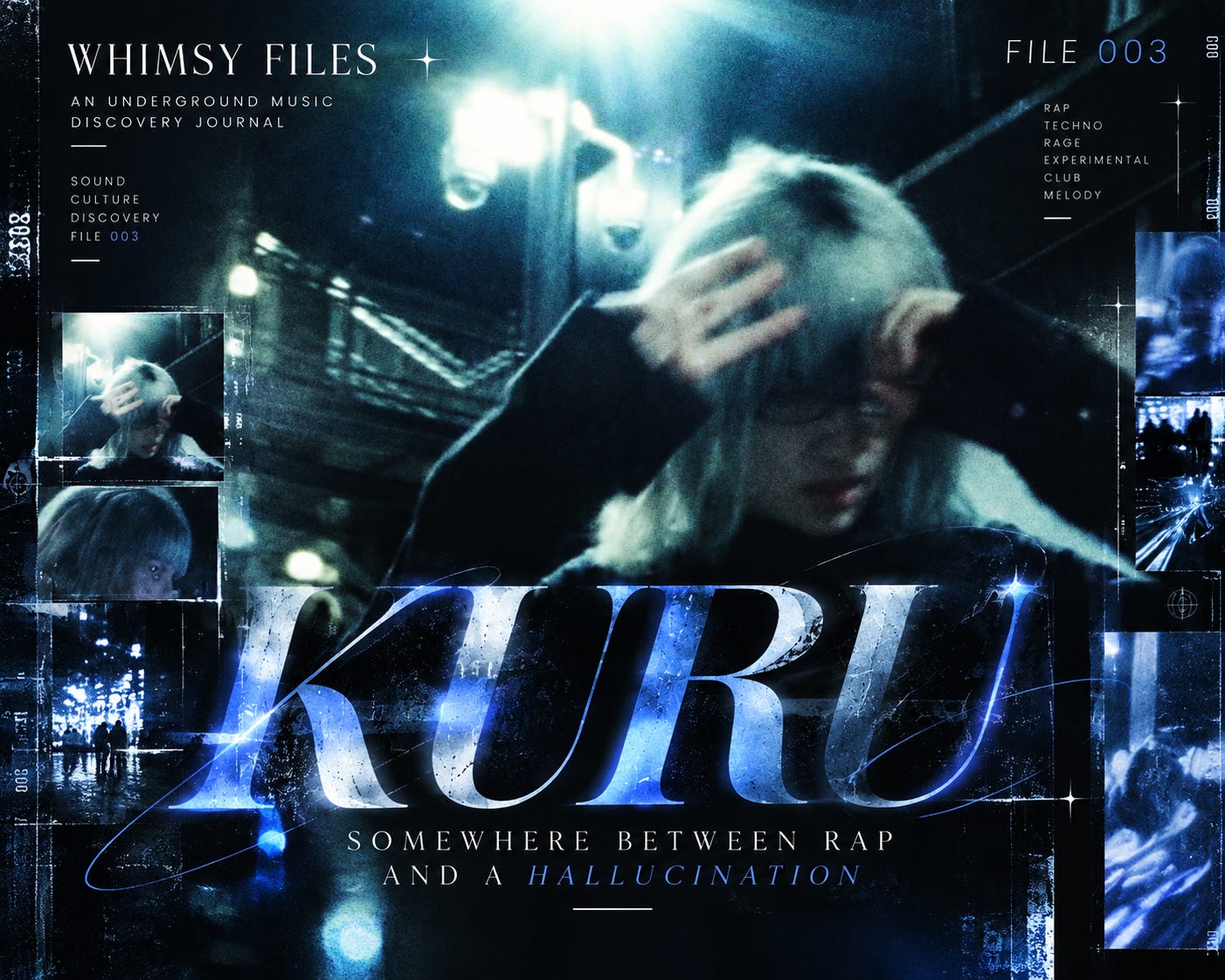
There’s a particular thrill that comes with discovering an artist whose music you can’t immediately categorize.
The cadence is familiar. The drums might belong to a trap record, the synths to an underground rave, and the melodies to something entirely different. But just when you think you’ve figured out where the song is going, the production shifts, the tempo changes, or the vocals slip into another dimension.
Enter kuru.
Somewhere at the intersection of hip-hop, techno, rage, and experimental electronic music, kuru creates a sound that feels simultaneously futuristic and strangely familiar. His music is unpredictable without feeling directionless, experimental without sacrificing rhythm, and melodic without abandoning the foundations of rap.
What makes him particularly compelling isn’t simply his willingness to experiment. It’s how effortlessly he moves between these sounds.
One moment, he’s delivering a smooth, almost weightless rap flow. The next, he’s floating over electronic production that sounds better suited to a warehouse rave than a traditional hip-hop record.
And somehow, it works.
01 / RAP IN MOTION
The first thing that stands out about kuru is his flow.
Even when the production becomes increasingly unconventional, his delivery remains remarkably fluid. There’s an ease to the way he moves across a beat, whether he’s rapping over bass-heavy trap production or something closer to techno.
On “can live w that,” his cadence is unmistakably rooted in hip-hop, but the instrumental pushes into electronic territory. His flow grounds the record while the production pulls it somewhere unexpected.
“Shibuya Transfer” demonstrates another side of that ability. Leaning more heavily into trap, the track gives his delivery room to take center stage. He doesn’t need unusual production to hold your attention; the flow itself is enough.
Then there’s “Good Game.”
Driven by a fast-moving beat and infectious rhythm, the track highlights one of kuru’s most compelling qualities: the way his rapping and melodic vocals seem to melt into each other.
Rather than treating singing and rapping as separate modes, he moves between them almost instinctively. The result is rhythmic, melodic, and undeniably danceable.
It’s the kind of record you could imagine hearing in a club, even as it resists the structure of a conventional dance track.
Kuru doesn’t sound like an electronic artist occasionally experimenting with rap, or a rapper simply borrowing sounds from dance music.
He sounds comfortable inhabiting both worlds.
02 / THE ART OF CONTROLLED CHAOS
If kuru’s flow provides the foundation, his production choices are where things become particularly fascinating.
Take “Pray For.”
The track feels almost hallucinatory. Its electronic textures create a dazed, disorienting atmosphere before the intensity begins to build. There’s something nearly sinister about the production, though it never fully settles into darkness.
Instead, the song feels suspended somewhere between exhilaration and unease.
It’s immersive, strange, and difficult to compare to anything else.
“Noir Kei” offers another example of this experimentation, transitioning between rap and techno influences in a way that makes the transformation itself part of the experience.
On “Like Glue,” featuring katmoji, the electronic elements move even further into the foreground, demonstrating how far kuru is willing to venture beyond conventional hip-hop production.
Then there’s “Don’t Get Stuck,” which channels a more recognizable rage sound.
The energy is immediate: pounding production, mosh-pit intensity, and the atmosphere of an underground club illuminated by flashing lights. It’s reminiscent of the sonic world associated with Opium, yet it sits comfortably alongside kuru’s more electronic experiments.
One track feels like a rave. Another feels like a hallucination. Another sounds like the soundtrack to a chaotic live show.
The sound changes. The identity remains.
03 / THE EMOTION BENEATH THE NOISE
For all the sonic experimentation, some of kuru’s most compelling moments are also his most emotionally revealing.
“Gracious” might be the clearest example.
The track opens with production that immediately commands attention: a hard-hitting beat with an almost cinematic quality. It feels made for a late-night drive, when the city is quiet, the roads are open, and the music becomes its own atmosphere.
But as the song progresses, something shifts.
The production transitions into a more intimate, melodic passage, and the emotional undertones become harder to ignore.
Beneath its colorful production is a complicated emotional landscape: romantic vulnerability, internal conflict, and the instinct to suppress feelings rather than fully confront them.
The contrast is striking.
A song that initially draws you in through its production gradually reveals something more personal.
A similar sense of intimacy emerges on “i love u wld never do it.”
Here, kuru’s delivery feels especially effortless. His voice seems to float across the bassline, following the groove with a smoothness that makes the song feel almost weightless.
On “Glass,” featuring xaviersobased, that emotional intensity takes a different form. His delivery feels urgent and passionate, with echoed vocals adding to the sense of contemplation.
These moments complicate the idea that experimental electronic rap is primarily about energy or spectacle.
Sometimes the most interesting thing happening beneath the distortion is vulnerability.
04 / A WORLD OF HIS OWN
One of the most exciting aspects of discovering kuru is realizing just how many different directions his music can take.
“End of Spring,” featuring Lucy Bedroque, is a standout.
The production is imaginative and unconventional, but there’s a natural chemistry between the two artists. Lucy’s contribution introduces a refreshing change in texture, complementing the track without disrupting its momentum.
It’s a collaboration that reflects the creative freedom of the internet underground, where artists aren’t necessarily confined by the expectations of a single genre.
Then there’s “Let the Keys Cry.”
If Pray For feels like a hallucination, Let the Keys Cry feels like an ascension.
Its melodic production and driving tempo create something almost cinematic. It’s the kind of track that makes an ordinary drive feel like a scene from a film, where the landscape stretches out ahead of you and everything seems briefly suspended in motion.
There’s an almost out-of-body quality to it.
And just when you think you’ve established the boundaries of kuru’s sound, “Three Worlds Apart” arrives with an entirely different sensibility.
Evoking a nostalgic, early-2000s pop atmosphere, the track reveals another dimension of his melodic instincts.
Across these records, the listening experience feels less like exploring a fixed genre and more like moving through a series of interconnected worlds.
Some are euphoric. Others are introspective. Some are built for movement, while others invite you to get lost in the atmosphere.
05 / BEYOND THE GENRE
There’s a tendency to describe experimental artists by listing all the genres they combine.
Rap meets techno. Hyperpop meets trap. Electronic music meets rage.
While those descriptions explain the individual ingredients, they rarely capture what makes the finished product interesting.
With kuru, the appeal lies in how seamlessly those influences coexist.
His music doesn’t always announce when it’s crossing from one genre into another. Sometimes a melodic passage dissolves into a rap verse, or a familiar rhythm gives way to an unexpected electronic breakdown.
Other times, the shift is immediate.
But beneath all these transformations, kuru remains an engaging rapper. His flow provides continuity even when the production ventures into unfamiliar territory.
And beneath the technical experimentation, there’s emotion.
The vulnerability of Gracious. The effortless groove of i love u wld never do it. The euphoria of Let the Keys Cry. The disorienting intensity of Pray For.
Together, they reveal an artist whose range is difficult to reduce to a single sound.
Perhaps that’s the point.
The most interesting thing about kuru isn’t that he’s combining genres.
It’s that he makes the boundaries between them feel increasingly irrelevant.
Sometimes you’re listening to rap.
Sometimes you’re somewhere in the middle of a rave.
And sometimes, you’re not entirely sure where you’ve ended up.
That’s where the fun begins.
THE WHIMSY ROTATION
Five tracks to enter kuru’s world.
01 / Gracious — Cinematic production, late-night drives, and unexpected emotional depth.
02 / Good Game — Effortless flows, infectious melodies, and club-ready energy.
03 / End of Spring (ft. Lucy Bedroque) — Inventive production and an effortlessly refreshing collaboration.
04 / Pray For — Hallucinatory, intense, and wonderfully unpredictable.
05 / Let the Keys Cry — Euphoric melodies and the feeling of floating somewhere outside yourself.
FILE 003 archived.
WHIMSY FILES
An underground music discovery journal.